2026 Will County Legal Opportunity Scholarship Recipient Named
2026 Will County Legal Opportunity Scholarship Recipient Named
By Rachel Barks
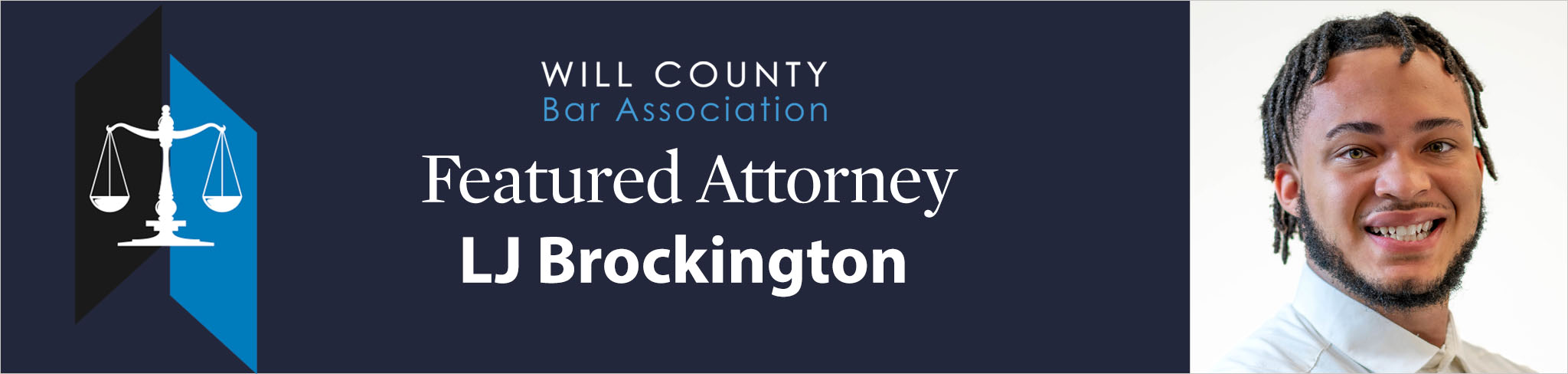
The Will County Bar Association, in collaboration with the Black Bar Association, Latino Bar Association, and Women’s Bar Association of Will County, has officially named its newest scholarship recipient: LJ Brockington, a Plainfield resident and current 2L at Northern Illinois University College of Law.
A driven, high-achieving scholar who grew up in Bolingbrook, LJ earned his associate degree from the College of DuPage before graduating from the University of Illinois at Urbana-Champaign in 2024 with high distinction in Political Science and a minor in Criminology.
“When I received the call that I was the recipient of the scholarship this year, I was beyond excited to the point that I did not have any words,” LJ said. “I applied and interviewed for the scholarship prior to my first year of law school, but unfortunately, I was not selected. Just like in any other aspect of life, there will be setbacks, but if you stay persistent, you will eventually overcome them and achieve your goals. Hard work truly does pay off.”
LJ brings a practical depth to the legal field, having interned over the past three summers with his mentor, local attorney John Schrock. During a complex wrongful shooting investigation involving the Will County Sheriff’s Office, LJ analyzed body camera footage to help determine that a client was innocent, key evidence that helped secure a fair settlement for them. LJ has also written briefs and worked on multiple defamation cases that Schrock’s firm successfully won.
“LJ is remarkable at handling sets of complex information,” Schrock said. “He has a good ability to analyze it and apply it to a case. He’s writing at a level of a third or fourth level associate; he’s way ahead of the game as far as practicing law. I consider myself to be his mentor.”
For LJ, the mentorship has proved transformative. “Working with Mr. Schrock has turned into an opportunity of a lifetime that I will forever be grateful for,” LJ shared.
“There have been times where I lacked confidence and questioned pursuing a legal career, however, Mr. Schrock has shown me that the most important skills that lawyers have, are indeed skills that I possess.”
Designed to promote diversity and opportunity within the local legal community, the Will County Legal Opportunity Scholarship offers second-year law students like LJ $10,000 for their second year law school tuition, $5,000 for their final year, an additional $1,000 toward bar preparation as well as additional funds if the recipient commits to practicing law within Will County upon graduation. First-year law students are also eligible to apply. The program also provides possible internship opportunities with the Courthouse, State’s Attorney’s Office, Public Defender’s Office, and local firms.
“This scholarship is a stepping stone toward allowing recipients to build meaningful relationships within the legal community,” LJ said. “It serves as a reminder that despite being a first-generation law student, my background does not define the limits of what I can accomplish. Will County is a community that recognizes the importance of diversity in the legal profession especially considering that people from different types of backgrounds are involved with the legal system.”
Looking toward the future, LJ aims to launch a non-profit organization in Will County, with other attorneys who share the same passion, dedicated to providing resources and legal representation for wrongfully convicted individuals.
LJ offers advice to future applicants of the Will County Legal Opportunity Scholarship, telling them to not give up or be scared to apply again if they apply the first time and do not receive the scholarship.
“One of the most joyous parts has been sharing the good news,” LJ added. “I look forward to giving back to the Will County legal community.”
Nominate an Attorney
Eligible nominees must be a WCBA Member in good standing, and individuals cannot nominate themselves or members of their own firm.
The Board will review all nominations monthly and select one nominee to be featured. Individuals not selected will remain as nominees for future features.
If there are any questions please reach out to info@willcountybar.org or
(815) 726-0383.